Dachau, Germany · October 17, 2026
Nobody tells you about the bicycles.
The road out of Munich is 20 minutes of the most unremarkable scenery in Bavaria—allotment gardens, a discount supermarket, a stretch of two-lane blacktop under a sky doing something enormous with its clouds. Then a sign announces the name, and the air in the car seems to change. Dachau. A word that arrives with its own gravity.
I had come to confront the past. What I hadn't planned for was the present, which was already waiting at the curb.
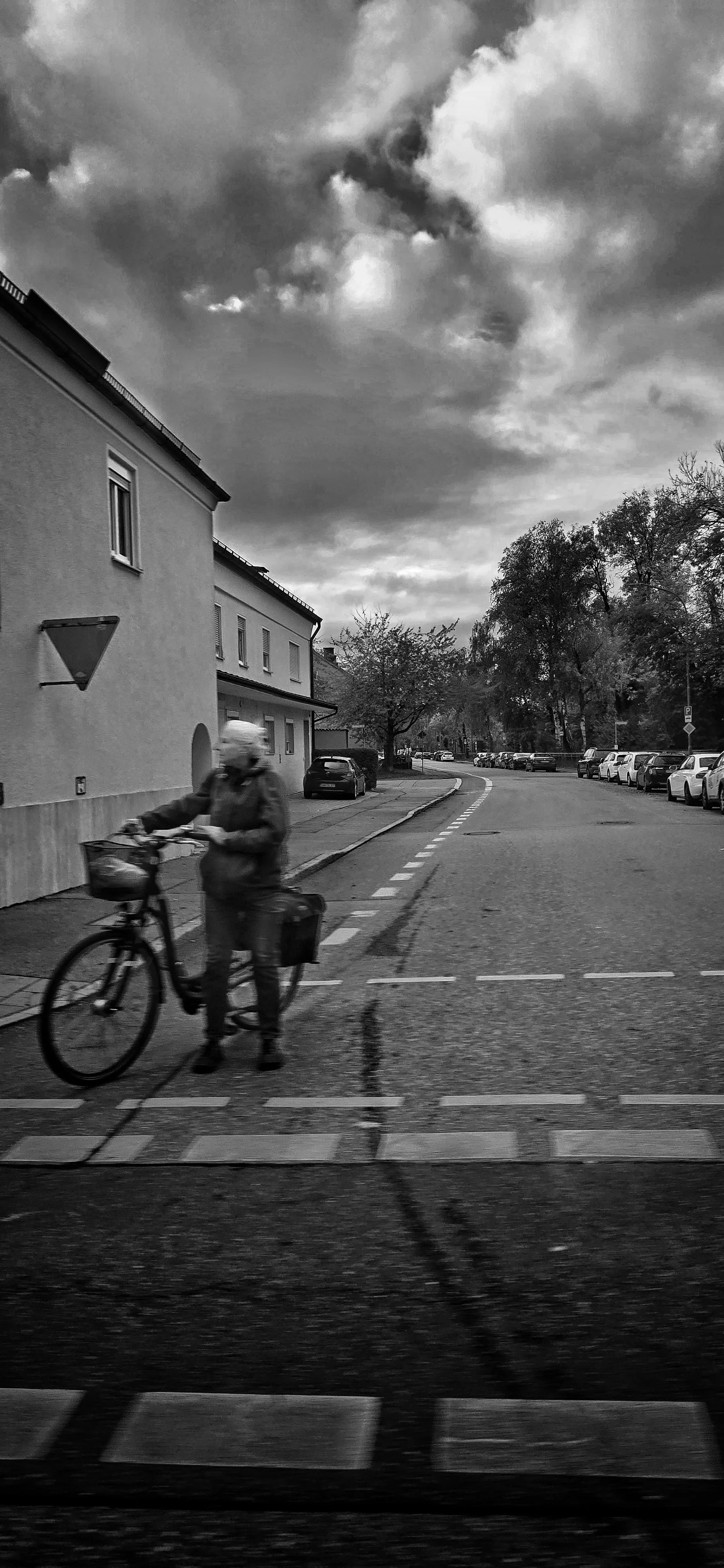
A woman in a knit cap wheels her bicycle across a residential street, a loaf of something wrapped in paper riding in the front basket. The car was moving and so was she, and the shutter rendered her a little ghostly—edges softened, face a smudge of light, while the houses behind her stayed perfectly sharp. A neat accident. In this town, the effect lands harder than it should.
Behind her, stucco houses with their shutters half-drawn. A line of parked hatchbacks. A speed-limit sign. An October afternoon so ordinary it could be any town in Europe—except that it isn't, and everyone here knows it.
For roughly 48,000 people, this is simply home. They buy groceries here. Their kids learn to ride bikes on these sidewalks. They give their address without flinching, because what else would they do?
It raises the question that followed me the rest of the day: What happens when you live inside a name the whole world uses as shorthand for atrocity? Does history settle into the routine of a place, like weather, until it's just part of the light? Or does routine slowly win—pushing the past a few meters further down the road each year, until it becomes something you drive past rather than through?
Maybe both are true at once. Maybe that's the only way a place like this can survive: by refusing to choose between remembering and living.
I didn't have answers. I had a camera, a window, and a few seconds of a stranger crossing the street before the light changed. What stayed with me was the arithmetic. The distance between an ordinary Tuesday and the darkest chapter of the 20th century is, it turns out, about one block.
The woman reached the far sidewalk, adjusted her bag, and pedaled off toward whatever came next.